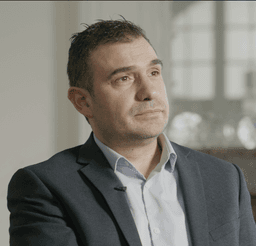
Lionnel Joussemet
Diota
Transcript
My name is Lionel Joussemet. I am one of the co-founders of DIOTA, a company I led from its creation in 2009 until its acquisition by the Dassault Systèmes Group in 2022. DIOTA offered technological solutions for the industrial sector. It was founded on a value proposition based on the conviction that we could significantly contribute to the performance of industrial sites, production centers, and maintenance centers by leveraging and utilizing digital data, which until then had been used solely by design offices and engineering departments within the industry. To achieve this, we developed a number of technologies for which we consistently positioned ourselves as a European leader. These technologies, through augmented reality, artificial intelligence, and robotics, enabled us to materialize this digital data on industrial operational sites in order to improve productivity and product quality. If we look at a rather emblematic case in aeronautics, for example, the case of fuselage panel inspections. These are elements that are actually very configurable since electrical harnesses must be able to be routed in different ways depending on the aircraft's configuration. Operators were often lost because they had paper instruction sheets that didn't allow them to understand what they had to inspect. And thanks to our augmented reality solutions, and thanks to artificial intelligence that enabled them to perform these inspections, they could reliably and quickly carry out checks on fuselage panels. In 2021, with the partners of DIOTA, including several investment funds, we made the decision to embark on a process of selling the company. Being a first-time entrepreneur myself, I didn't necessarily have relationships with investment banks that could support us. So I asked my colleagues to recommend several investment banks, for which we had established a number of criteria to select the best partner to support us. These criteria included an understanding of the technology, an understanding of the market for these technologies, particularly the market of potential buyers, and finally, the human element related to the ability to collaborate within a process that is, after all, quite demanding, both technically and emotionally, for a leader. Therefore, it was important to find partners who could support us. And so, quite naturally, we met with several investment banks, whose staff were generally very finance-oriented, which is normal; it's their business. But it's true that it was only at IPTP that I found a firm that also had the ability to understand the technological and market challenges facing our company. Presenting a genuine track record with major global players and groups likely to acquire DIOTA, and finally, a relational approach, a human dimension, an entrepreneurial dimension that, at least among the investment banks I visited, was unparalleled. Within the framework of this support from IPTP, one of the truly structuring and decisive elements was this investment bank's ability to structure our process, not only through accounting and financial visibility and the company's results, but also through a truly market-driven and strategic approach. In the sense that we were looking for an acquirer who wasn't seeking billions in growth or anything like that, but rather a technological potential that would ultimately allow it to gain a significant advantage and enable it, with its own resources, to scale the technology into major markets. And truly, I think that's a signature of this investment bank. This process also allowed us to hold our ground throughout, because selling a company is something that takes quite a long time — for us, it lasted 9 months. So the idea was also to be able, in our tactical approach but also in our strategic approach, to determine which player to approach initially, with what elements, which player to put in competition with whom, and so on. Thanks to this process, we really found ourselves with something very structured, which, as an engineer, helped me to be effective — and I think that was one of the important elements. Among other elements, I think we can highlight, within the framework of this support process provided by IPTP for this sale, particularly with the Dassault Systèmes Group, not only the IPTP partners' knowledge of the rules of the game, but also a genuine understanding of how the Dassault Systèmes Group's M&A team operates. The idea is that we are dealing with people who have very high standards, both in understanding the technology we are offering and in understanding the implementation that the management team envisions. And it's true that in these contexts, it wasn't necessarily easy to understand our interlocutors' perspective. In this context, the collaboration with the IPTP partners allowed us, I think, to offer a level of information and a level of presentation of our project that enabled our interlocutors to envision themselves in an acquisition. After the project presentation phase during which we presented the company to various potential buyers at a pace that was tactically aligned with the primary target we had identified, we were able to quickly find potential buyers — companies that understood the value proposition we were offering and that were seriously considering adding it to their portfolio. And we quickly found ourselves in a situation where IPTP was a great help, as it involved managing a competitive environment with several potential buyers vying for our attention. Having access to the experience of the IPTP partners, as well as their knowledge of our contacts within all these groups, really allowed us to quickly narrow down the options, or at least evaluate the buyers for whom an acquisition didn't make sense, to focus specifically and effectively on the real potential buyers, including the Dassault Systèmes Group. Selling a company is a challenging process, with its ups and downs, good news and sometimes bad. And in these situations, it was crucial for me, as a leader, to feel supported by people who had gone through similar experiences. One of the things I really appreciated as a first-time entrepreneur was IPTP's ability to gauge its involvement, not so much in project monitoring, but in decision-making. I was dealing with people who, in a very structured and well-reasoned way, were able to suggest directions I could prioritize. But ultimately, it was me, with input from my partners, who made the decisions and ultimately decided how we would steer the process. And I think that's also part of what contributed to the trust that developed between the IPTP team and myself as the leader. Would I entrust IPTP once again with a new business project? Without a doubt.